join my team @ university of glasgow
What am I looking for?
I am always interested in hearing from curious, motivated researchers who would like to work with me. This includes prospective PhD students as well as postdoctoral researchers seeking to develop a fellowship proposal. I welcome people who are excited about human-computer interaction, extended reality, and empirical research, and who are keen to contribute their own ideas while growing as independent researchers. If your interests broadly align with my work, I would be happy to hear from you. I am especially keen on receiving applications in the following fields of research:
Info for PhD applicants
I very much enjoy working with research students. I have experience guiding student research and am currently available to supervise new research students at the University of Glasgow within the Glasgow Interactive Systems (GIST) section.
For an initial overview of degree options, entry requirements, fees, and funding, I recommend checking out the University of Glasgow’s pages on postgraduate research degrees in Computing Science. Each year, several studentships and scholarships are available. Have a look for details, especially the sections on School of Computing Science Studentships, Minerva Scholarships, and College Scholarships. The next application deadline for scholarships will likely be January 31, 2027. I am always happy to receive applications from students who do not need a scholarship and want to self-fund.
For graduates and undergraduates: I am happy to discuss applications from prospective PhD students who want to self-fund any time.
Details
- Institution: University of Glasgow, GIST Section
- Primary Supervisor: Dr. Florian Weidner (that's me)
- Secondary Supervisor: To be discussed.
- Funding: Competitive funding options are available for students who apply by the 31 January 2027 deadline. Self-funded possible.
- Start (on acceptance): Oct 2028 or later
Requirements
- Educational Background: B.Sc./M.Sc. in HCI, Game Development, Machine Learning, Computer Vision, Human-centred Computing, or related fields.
- Technical Skills: Strong foundation in AR/VR development. Experience in machine learning a plus.
- Language Proficiency: Excellent written and spoken English skills.
- Communication Skills: Strong academic writing and presentation abilities.
- Curiosity, independence, and motivation are as important as specific technical expertise.
Get in Touch!
If you are interested, please reach out to me at florian.weidner [at] glasgow.ac.uk. I look forward to hearing from you. Please include:
- Your CV (long form),
- your publications or latest thesis,
- your transcripts / grades from your current or most recent degree,
- a short description of how your prior experience matches my area of research (max. 200 words),
- an idea of your research direction (max. 200 words), and
- no cover letter needed.
>>> Incomplete applications will not be considered.
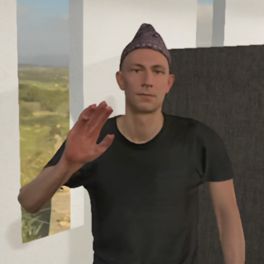
XR Productivity: This project explores how AR and VR can enhance remote collaboration to match or surpass face-to-face communication. Focusing on verbal and non-verbal cues, particularly gaze and facial expressions, it aims to replicate and enhance social and mutual gaze, even without eye-tracking. The results could transform remote meetings, connect people across distances, and support sustainability by reducing travel. It involves AR/VR development, animation of virtual humans, and user studies, with flexibility for you to shape the research direction and acquire necessary skills.

This topic explores how extended reality (XR) can support comfortable and efficient digital work. By studying user ergonomics and interaction patterns, it aims to develop principles for sustainable and adaptive virtual work environments that enhance productivity and well-being. The outcomes will contribute to the future of digital work, remote collaboration, and hybrid productivity tools. Methods include AR/VR prototyping, motion and posture analysis, and mixed-methods user studies. The project is flexible and interdisciplinary, allowing you to shape its direction and develop new skills along the way.

This project investigates how virtual agentic self-representations can shape the way people work, communicate, and express themselves in immersive environments. The research will explore how such representations influence perception, presence, and interaction, contributing to more natural and adaptive user experiences in XR. The project may involve AR/VR development, behavioral analysis, and mixed-methods user studies, depending on the student’s interests and expertise. Not all skills need to be present at the start, as they can be developed during the project. The project offers flexibility and can evolve in several directions, allowing you to shape their own innovative and interdisciplinary research path.
In addition to those, I welcome proposals from people interested in designing and studying novel interaction techniques in XR. You are encouraged to propose your own topic, provided it aligns with my broader interests in immersive technologies. My research focuses on interaction, productivity, and communication in everyday AR/VR applications. I investigate how users perceive and engage with virtual content—such as through gaze, posture, smell, or taste—and how they express themselves via avatars. My work combines technical prototyping (e.g., Unity, Arduino) with empirical evaluation to enhance user performance, experience, and ergonomics. I take an empirical HCI approach, involving the development of interactive systems, the design and execution of user studies, and the analysis of user behaviour using both quantitative and qualitative methods.